
AEO vs SEO vs GEO: What Businesses Need to Know in 2026
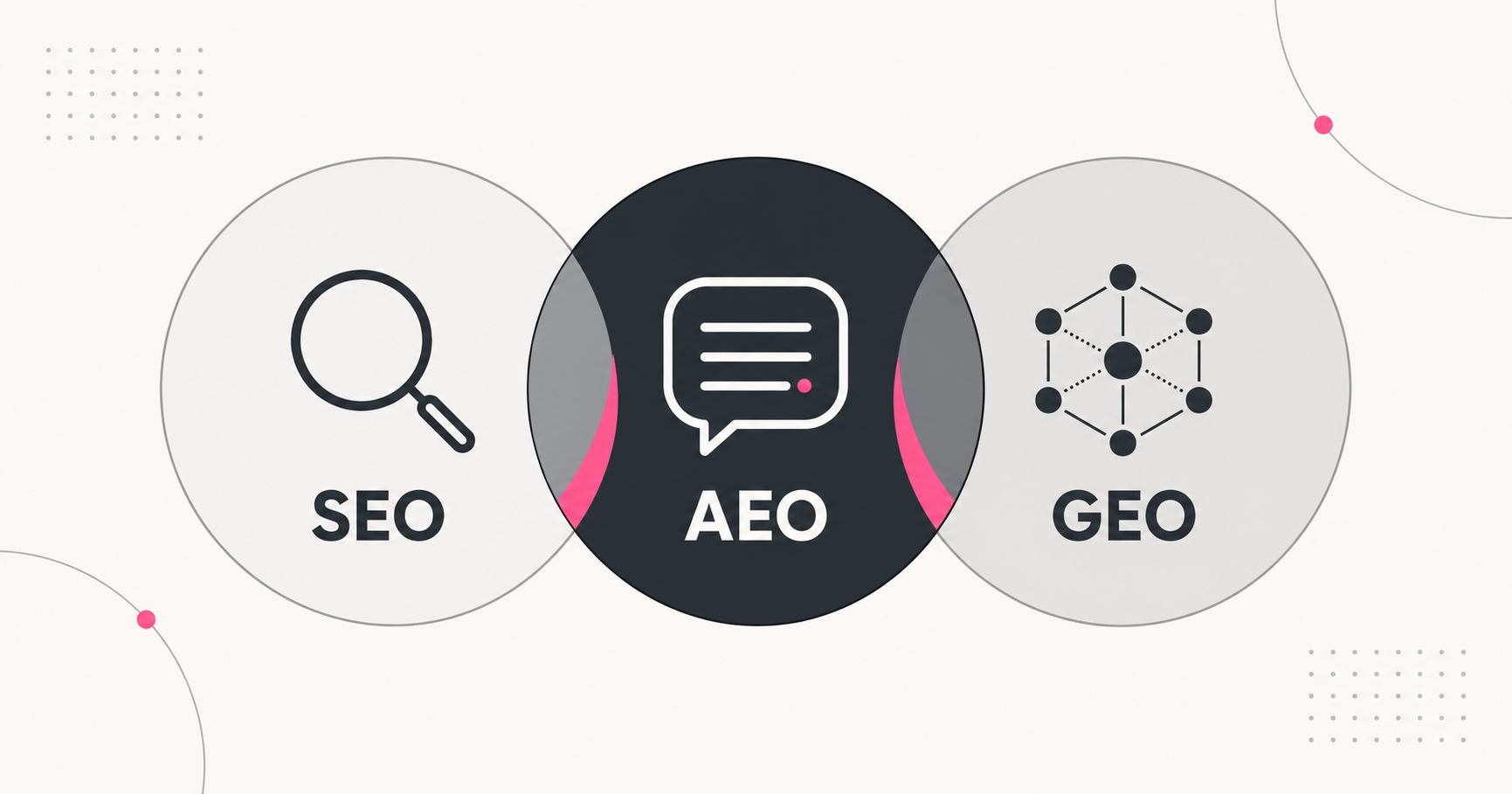
In 2026, SEO, AEO and GEO are not three separate marketing strategies. SEO helps search engines discover and rank your content, AEO makes it easier to extract a direct answer, and GEO improves the likelihood that generative AI systems can understand, reference and surface your brand. The strongest approach uses all three together, with solid SEO as the foundation.
Quick Takeaways
SEO builds discoverability, rankings and organic traffic across traditional search results.
AEO structures information so answer engines can identify a clear, reliable response.
GEO focuses on AI visibility when generative systems compare, summarize or recommend sources.
All three depend on useful content, clear structure, technical accessibility and trustworthy evidence.
There is no guaranteed AI visibility hack; businesses should strengthen the same fundamentals that make a page valuable to people.
What Does SEO Mean in 2026?
SEO, or search engine optimization, helps search engines understand a page and helps users decide whether to visit it. Traditional SEO still includes matching search intent, choosing relevant keywords, writing clear titles and descriptions, building internal links, earning authority and maintaining a technically healthy website.
Those fundamentals also support SEO for AI search. Google's official 2026 guidance for generative AI features states that core SEO best practices remain relevant because AI search experiences still rely on search indexes, ranking systems and retrieved web pages.
For a business, that means the starting point has not changed: publish genuinely useful information on a fast, crawlable website, organize it clearly and connect each page to the services or decisions your audience cares about.
What Is Answer Engine Optimization?
Answer engine optimization, or AEO, makes content easier to understand and use as a direct answer. Instead of forcing a reader to search through a long introduction, an AEO-friendly page answers the main question early, uses descriptive headings and supports the answer with context or evidence.
AEO can support visibility in featured answers, conversational search experiences and AI-generated summaries. It is not simply adding dozens of FAQs or repeating the same keyword. Strong AEO is concise, accurate and easy to verify.
What Is Generative Engine Optimization?
Generative engine optimization, or GEO, is an industry term for improving how clearly a brand and its expertise can be understood within generative AI experiences. These systems may combine information from multiple sources before producing a comparison, recommendation or explanation.
GEO therefore places extra attention on original insight, consistent business information, strong topic coverage, credible references and content that adds something beyond a generic summary. The goal is not to write for a robot. It is to become a clear, useful and trustworthy source that an AI system can confidently interpret.
AEO vs SEO vs GEO: How Do They Compare?
SEO
Main goal: Earn visibility and qualified traffic from search results.
Primary focus: Crawling, indexing, relevance, authority and user experience.
Typical tactics: Keywords, metadata, internal links, technical SEO and helpful content.
Success signals: Rankings, impressions, clicks, engaged traffic and leads.
AEO
Main goal: Provide a clear answer to a specific question.
Primary focus: Direct answers, question-led headings and concise explanations.
Typical tactics: Answer-first copy, FAQs, lists, definitions and structured sections.
Success signals: Answer placements, qualified visits and stronger engagement.
GEO
Main goal: Improve visibility and references in generative AI responses.
Primary focus: Original expertise, entity clarity, evidence and broad topic context.
Typical tactics: Expert insight, named sources, consistent brand facts and useful comparisons.
Success signals: AI referrals, brand mentions, cited visibility and assisted conversions.
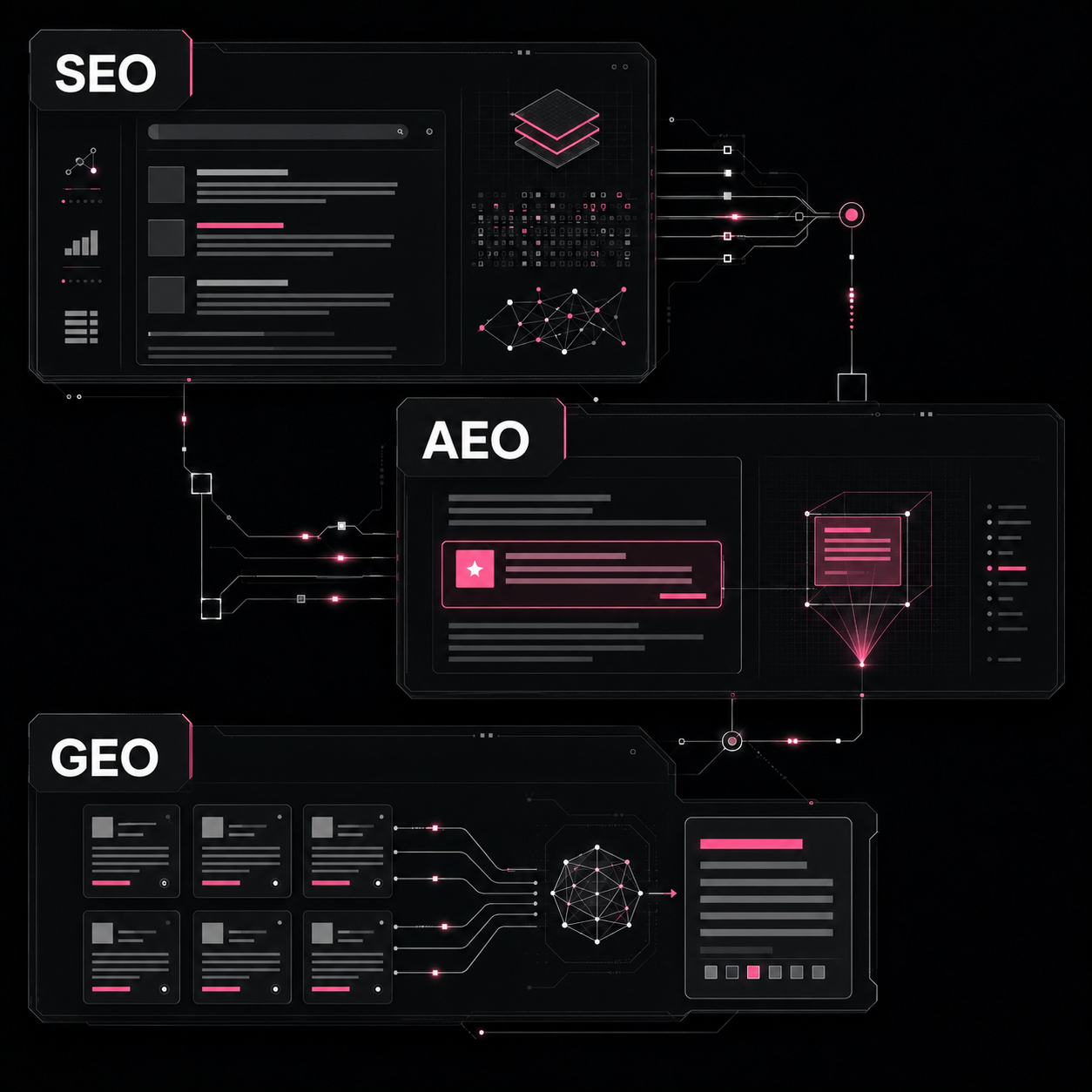
Do Businesses Need Three Separate Search Strategies?
No. Businesses need one connected search visibility strategy. Google specifically describes AEO and GEO as terms used for work focused on AI search visibility, while viewing optimization for its generative search experiences as part of SEO.
That does not make AEO or GEO meaningless. The terms are useful because they remind teams that people no longer discover information through one list of blue links. However, creating separate pages for every keyword variation, stuffing questions into an article or chasing unsupported AI hacks can weaken content rather than improve it.
Google also states that special AI files, special schema and tiny content "chunks" are not required for visibility in its AI features. Structured data can still help search engines understand page details and qualify content for rich results, but it must match the visible content on the page.
How Can Businesses Optimize for SEO, AEO and GEO Together?
1. Choose one clear search intent: Decide what question the page answers, who is asking it and what decision they need to make.
2. Answer the main question early: Provide a useful 40–70 word answer near the top, then expand with the detail the reader needs.
3. Add information only your business can provide: Use real examples, original observations, client questions, processes, data or expert commentary instead of repeating generic advice.
4. Make the content easy to interpret: Use descriptive H2s, short paragraphs, accurate definitions, comparison tables and FAQs where they genuinely improve clarity.
5. Strengthen the website around the content: Keep important text crawlable, add descriptive internal links, optimize images and maintain a fast, mobile-friendly experience.
6. Connect visibility to a business outcome: Track qualified visits, enquiries and sales—not visibility alone. Review the page with FIFTH's digital services in mind so the content naturally guides the right reader toward a useful next step.
Which Approach Should Your Business Prioritize?
Start with SEO, then strengthen the same pages with AEO and GEO principles. If a website is difficult to crawl, unclear about its services or filled with generic content, AI visibility will be difficult to build reliably.
A strong priority order is: fix technical and content foundations, answer high-value customer questions, add original expertise, clarify the brand and measure whether visibility creates meaningful action. For businesses with an outdated or hard-to-navigate site, professional website development may be part of the solution before additional content is produced.
Frequently Asked Questions
Is GEO replacing SEO?
No. GEO does not replace SEO. Generative systems still need accessible, relevant and trustworthy information. SEO creates that foundation, while GEO emphasizes how clearly a source can be understood, compared and referenced within generative responses.
Is AEO only for voice search?
No. AEO can support any experience that provides a direct answer, including featured results, conversational search and AI-generated summaries. Its core principles—clear questions, concise answers and useful supporting detail—also improve the experience for human readers.
Does a website need special schema or an llms.txt file for AI visibility?
Not for Google Search. Google states that there is no special schema or AI text file required for its AI features. Standard structured data may still support rich results when it accurately reflects visible page content.
How long does SEO, AEO or GEO take to work?
There is no guaranteed timeline. Some search changes may be processed quickly, while meaningful visibility and lead growth often require ongoing improvement over weeks or months. Measure progress through search visibility, qualified traffic, enquiries and any trackable AI referrals.
Build Search Visibility That Supports Growth
SEO, AEO and GEO work best when they are treated as connected layers—not competing trends. The real opportunity is to make your business easier to discover, understand and trust wherever customers search for answers.
Want to know how visible your business is across search and AI experiences? Request an SEO/AEO audit from FIFTH to identify content, technical and conversion opportunities. Contact FIFTH.